
Your Cart is Empty


Effective CPAP therapy can significantly reduce your risk of serious health problems, with one large analysis showing CPAP users have up to a 37% lower risk of death from any cause and a 55% lower risk of cardiovascular death when they use their device consistently. Choosing the right ResMed CPAP machine is therefore not just about comfort, it is about long‑term health. In this comparison, we walk through the key differences between the ResMed AirSense 10, the newer AirSense 11, and the ultra‑portable AirMini range, so you can clearly see which device is likely to suit your sleep apnoea needs best.
| Question | Answer |
|---|---|
| 1. What is the main difference between ResMed AirSense 10 and 11? | The AirSense 11 builds on the AirSense 10 with a modern touchscreen, over‑the‑air software updates, and guided digital support features like Personal Therapy Assistant and Care Check‑In, while keeping the same trusted AutoSet therapy modes. |
| 2. Which ResMed CPAP is best for most home users? | For most people starting or upgrading therapy, the AirSense 11 AutoSet 4G is the best all‑round choice due to its combination of comfort features, digital coaching, and future‑proof connectivity. You can view it here: ResMed AirSense 11 AutoSet 4G CPAP Machine. |
| 3. Is the AirSense 10 AutoSet still a good option? | Yes. The AirSense 10 AutoSet remains a very capable and reliable CPAP with integrated humidifier, AutoRamp and advanced event detection, and it is often available at a keener price than the AirSense 11. |
| 4. Who should consider the AirMini instead? | The ResMed AirMini is ideal for frequent travellers or anyone wanting a compact secondary device while keeping a full‑size AirSense machine at home. |
| 5. Does the AirSense 11 improve comfort compared with the AirSense 10? | Both offer AutoRamp and EPR for comfort, but AirSense 11 adds enhanced digital coaching and Care Check‑In to help you fine‑tune comfort settings and stay on therapy more consistently. |
| 6. How do the machines handle humidification? | AirSense 10 and 11 both feature integrated heated humidification and Climate Control, with optional heated tubing for better moisture control. AirMini uses compact HumidX solutions for travel‑friendly moisture. |
| 7. Which ResMed CPAP is the quietest? | Both the AirSense 10 and 11 use ResMed’s quiet Easy‑Breathe motor technology, with the AirSense 11 AutoSet measured at around 27 dBA, which is considered very quiet for bedside use. |
ResMed’s current CPAP line‑up for treating obstructive sleep apnoea revolves around three key families. The AirSense 10 series, the newer AirSense 11 platform, and the ultra‑compact AirMini travel machines. Each covers a different need, from everyday home therapy to portable solutions.
All ResMed CPAP devices we discuss here are designed for use under medical supervision. They deliver continuous positive airway pressure to help prevent airway obstruction, but the way they personalise, record, and support therapy is what separates one model from another.
The AirSense 10 AutoSet has built a strong reputation as a dependable home CPAP. It combines an integrated HumidAir humidifier, optional ClimateLine heated tubing, and features like AutoRamp and advanced event detection in a familiar button‑based interface.
For many users, the AirSense 10 AutoSet remains a cost‑effective and clinically robust choice, especially when purchased in a machine and mask package.


When you compare the ResMed AirSense 10 AutoSet with the AirSense 11 AutoSet, it is useful to start with the fundamentals. Both machines provide automatic pressure adjustment within a wide range and include similar core therapy algorithms.
The main shift with AirSense 11 is not in raw pressure performance, but in how the device supports you from your first night and adapts over time.
The AirSense 11 AutoSet starts at a default minimum pressure of 5 cm H₂O, while the AirSense 10 AutoSet usually starts at 4 cm H₂O. In practice, your clinician or our team will adjust these settings to match your prescription and comfort needs.
Both AirSense 10 and 11 support advanced event detection. They can distinguish between obstructive sleep apnoea events and central apnoea events, which are often managed with different therapy approaches such as Bi‑level or ASV.
The AirSense 11 builds on this with improved reporting to your clinician through AirView and more detailed nightly data to support remote adjustments and follow‑up.


Comfort is central to successful CPAP therapy. ResMed has gradually refined its comfort features from the AirSense 10 to the AirSense 11, without changing the basic principles that already work well.
Both machines include AutoRamp with sleep onset detection and Expiratory Pressure Relief (EPR), but the way these features are supported and adjusted is slightly different in AirSense 11.
The result is a smoother adjustment to therapy, particularly in the first few nights. In practice, many new users report that AutoRamp and EPR are the features that make CPAP feel less “forceful”.
For users who are sensitive to dryness, nosebleeds, or congestion, these humidification options are often essential. AirMini uses compact HumidX inserts instead, which we cover later in the article.

This is where the ResMed AirSense 11 steps ahead of the AirSense 10. Both devices can share data with clinicians via AirView, but only the AirSense 11 layers in a more guided experience from the moment you open the box.
These tools are particularly useful if you are starting CPAP therapy for the first time or if you have struggled with comfort and consistency in the past.
AirSense 11 integrates with the myAir app to provide a Personal Therapy Assistant. This feature offers interactive, voice‑guided video instructions that walk you through setting up your equipment, fitting your mask, and getting used to therapy.
Instead of relying only on printed manuals, you can follow clear, step‑by‑step guidance on your phone or tablet, which many users find easier when they are tired at the end of the day.
In the first month of therapy, the AirSense 11 offers Care Check‑In, a series of time‑based questions on how you are sleeping, how your mask feels, and whether you are having issues. Based on your responses, the system provides targeted tips and support.
If you opt in, your Care Check‑In responses also flow through to your AirView record, so your clinician has a fuller picture of how you are coping and can intervene sooner if needed.

Beyond clinical features, you will feel the difference between AirSense 10 and 11 in daily use. This includes how quiet they are, how easy they are to operate when you are half asleep, and how they look and feel on your bedside table.
ResMed has refined these practical aspects with each generation, which is particularly evident in the AirSense 11’s touchscreen interface.
The AirSense 11 AutoSet uses the quiet Easy‑Breathe motor, similar in concept to the AirSense 10, designed for low vibration and soft sound. Published measurements put the AirSense 11 AutoSet at around 27 dBA, which is comparable to a soft whisper in a quiet room.
This low noise level helps many people share a room or bed more comfortably, especially in quiet environments where machine noise can be distracting.
Both machines offer a simple Start/Stop function, but the AirSense 11 streamlines this further with a single prominent button and an ambient light sensor that automatically adjusts the screen brightness and turns it off after a short period.

One of the biggest advances in modern CPAP therapy is the ability to monitor and adjust treatment remotely. This saves time, reduces unnecessary appointments, and helps you and your care team respond quickly if something is not working.
Both AirSense 10 and AirSense 11 are designed to work with ResMed’s remote systems, but AirSense 11 is more connected by default.
Both devices can send nightly therapy data to AirView, which clinicians can use to review your progress and, in many cases, adjust your device settings remotely through the Remote Assist feature.
While AirSense 10 users can also use myAir to view basic sleep scores and guidance, the AirSense 11 has been designed from the ground up with the myAir experience in mind. It is better integrated, more interactive, and offers richer feedback on mask leaks, events per hour, and usage time.
In practice, this stronger integration helps many users stay engaged with their therapy, which is crucial for long‑term health outcomes.


Price is a key part of any CPAP machine comparison. While exact pricing can vary, we can give you a realistic sense of how these devices typically sit relative to each other, based on current listings and market data.
Below is a simplified view of indicative pricing to help you understand the value each model provides for its feature set.
| Model | Typical Use | Indicative Price Range* |
|---|---|---|
| ResMed AirSense 10 AutoSet (with humidifier) | Primary home CPAP | Often below AirSense 11, good value for proven features |
| ResMed AirSense 11 AutoSet 4G | Primary home CPAP with digital coaching | Around mid to upper price tier, reflecting newer design and connectivity |
| ResMed AirMini Automatic CPAP Machine | Travel or secondary device | Approximately $990.00 for machine only |
| ResMed AirMini Travel CPAP Machine Pack | Travel kit with mask and accessories | Approximately $1,030.00 for a bundled pack |
*Prices are indicative and may change. Always check our current product pages for accurate pricing and any available offers.
For most users, the decision comes down to whether the additional support and future‑proofing in AirSense 11 justifies the extra cost compared with AirSense 10, and whether an AirMini is required as a dedicated travel option or simply a “nice to have”.
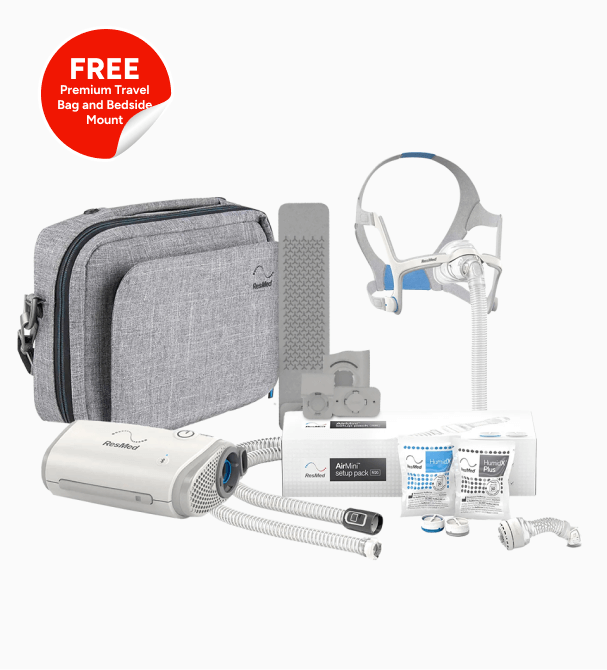
Although our focus is on AirSense 10 vs AirSense 11, many people also ask whether they should choose an AirMini instead of a full‑size device. In almost all cases, AirMini is best viewed as a travel or secondary unit, not a complete replacement for a bedside CPAP.
It uses the same AutoSet therapy principles but in a far smaller and lighter package, with some trade‑offs in humidification and noise control compared with full‑size devices.
Many of our customers keep an AirSense 10 or 11 on the bedside table and use an AirMini for work trips or holidays. This combination provides the best of both worlds, especially if you travel frequently but still want the full comfort of integrated humidification at home.

To bring the comparison together, here is a side‑by‑side look at the most important factors when choosing between these ResMed CPAP options.
| Feature | AirSense 10 AutoSet | AirSense 11 AutoSet | AirMini AutoSet |
|---|---|---|---|
| Primary Use | Home CPAP | Home CPAP with digital coaching | Travel / secondary device |
| Pressure Range | 4–20 cm H₂O | 5–20 cm H₂O default (adjustable, full range 4–20) | 4–20 cm H₂O |
| Therapy Modes | CPAP, AutoSet, AutoSet for Her (separate model) | CPAP, AutoSet, AutoSet for Her in same device | CPAP, AutoSet |
| Humidifier | Integrated HumidAir heated humidifier | Integrated humidifier with Climate Control and ClimateLineAir 11 compatibility | Waterless HumidX / HumidX Plus (selected masks) |
| Comfort Features | AutoRamp, EPR, AutoSet Response | AutoRamp with sleep onset detection, EPR, AutoSet Response comfort setting | AutoRamp and pressure relief equivalent tailored for travel |
| Digital Tools | myAir (basic), AirView, some cellular models | myAir with Personal Therapy Assistant and Care Check‑In, AirView with Remote Assist, over‑the‑air updates | AirMini app for data and control, Bluetooth connection |
| Interface | Screen with buttons and dial | Full‑colour touchscreen, simple Start/Stop button | Compact interface, app‑based control focus |
| Portability | Bedside focused | Bedside focused, slightly more compact footprint | Very compact, travel focused |
This table should help you quickly identify which machine aligns best with your therapy setting, comfort expectations, and lifestyle, before you dive into specific packages and mask choices.


When we help customers select between the ResMed AirSense 10, AirSense 11, and AirMini, we focus on a small set of practical questions. This keeps the decision clear and grounded in your actual nightly routine and medical needs.
You do not need to be an expert in CPAP technology to make a good choice. You simply need to be clear about how and where you will use the device, and what kind of support you would like around your therapy.
If you are unsure, we encourage you to contact us with your prescription details and a brief summary of your lifestyle. Our team is happy to talk you through the options and provide a tailored recommendation.

ResMed’s current CPAP line‑up offers clear choices for different needs. The AirSense 10 AutoSet remains a reliable, proven option for home therapy with integrated humidification and advanced event detection. The AirSense 11 AutoSet builds on that foundation with a touchscreen interface, Personal Therapy Assistant, Care Check‑In, and over‑the‑air updates, making it the most user‑friendly and future‑ready choice for most new and upgrading users.
The AirMini sits alongside these as a compact travel solution, ideal as a secondary device if you are often away from home. When comparing ResMed CPAP machines, the best approach is to match the device to your daily life, comfort preferences, and the level of digital support you want around your therapy. If you would like help comparing specific ResMed CPAP packages or understanding which machine suits your prescription, our team at Easy CPAP is here to assist you with clear, practical advice.